
Have you ever tried anything on Google where a couple of results on the top were marked as “Sponsored”? Well, those were Google search ads. They form the most effective marketing strategy of modern times and if you are a businessman, then knowing about them will certainly help you get more customers.
In this guide, we will tell you all about what Google search ads are, how they work, why do businesses use them, and finally, how to set up one yourself.

What Are Google Search Ads?
A Google search ad is essentially a paid advertising opportunity to appear in the search results of Google when users are searching for information pertaining to your products or services. What makes a search ad unique from other forms of organic listing, which require time and effort to earn good rankings, is that search ads can help your website appear right away – as long as you have the money to pay for it.
It is important to note that Google search ads operate under the Pay-Per-Click (PPC) principle, which basically implies that you will pay nothing for an ad that doesn’t get any clicks.
In essence, then, Google search ads are all about buying your way into visibility on Google.
How Do Google Search Ads Work?
Knowledge of these methods is vital in helping you utilize them better. Here are the simple steps involved in making such an advertisement.
Keyword Selection
The keywords are the words people search on Google. In the case of your plumbing company, your keywords can be phrases such as “emergency plumber near me,” “fix leaking pipe,” etc. The ad will become active whenever someone searches for the selected keywords.
Set up a budget and a bid
You determine how much you are willing to spend each time your ad gets clicked on, which is known as your bid. You can set your budget accordingly so that you don’t end up spending too much.
Google holds an auction
With every search query entered, Google holds an instant auction for all the companies interested in that particular keyword. In other words, it doesn’t depend only on the maximum bid you make but on both your bid and the Quality Score.
Quality Score is crucial
Google uses Quality Score as its way of determining the relevance and value of your ad. The following parameters are analyzed when determining the Quality Score:
- Relevance of your keywords in relation to the ad text
- Relevance of the ad in relation to the page where it leads to (your landing page)
- Expected click-through rate
Thus, a high Quality Score can reduce the cost per click; therefore, it’s not just about the large budget but also about relevance.
Your ad gets displayed
If you win the auction, your ad is displayed on the search engine results page, either above or below the organic listings as “Sponsored.”
Why Do Businesses Use Google Search Ads?
There are a few reasons why search ads have become very popular among businesses of all sizes.
- They have actual intent. As opposed to social media advertising where you interrupt users who are just scrolling through their newsfeed, search advertising reaches those who are already seeking something. If you enter “buy running shoes online,” you will definitely get them faster than if you look for the same product on Instagram.
- The results are quick. SEO might take months to bring results. Search advertising can get you on top of Google within hours of running a campaign.
- They are easily measured. All clicks, costs, and conversions are monitored. You know exactly how much you spend and what do you get from it.
- They are flexible. You can always pause, tweak, or scale up your campaigns depending on the performance.
Types of Google Search Ads
All search ads do not share the same characteristics and features. Here are the basic types of search ads:
- The text ad is one of the popular types of ads consisting of a headline, a description, and a link.
- A responsive search ad enables you to use several headlines and descriptions and Google tests which combinations work well.
- Dynamic search ads create headlines and landing pages automatically based on the contents of your website, especially when you have many products.
- Call-only ads are made for mobile customers and direct people to call your business.
Key Components of a Google Search Ad
To fully comprehend the search advertisements, it would be beneficial to know their components.
- Headline – a short and catchy text used as the first line in your advertisement.
- Description – two to three sentences describing your services or products.
- Display URL – the website address used in your advertisement.
- Extensions (or assets) – additional information such as phone number, website links, and location that makes your advertisement more informative and clickable.
How Much Do Google Search Ads Cost?
There isn’t a definite price – it depends a lot on your industry, competition, and selected keyword. Certain keywords will probably cost you a couple of cents per click, but competitive keywords (such as for insurance and law practices) can cost dollars per click.
The good thing is that you’re always in charge. You decide how much money to spend per day, and Google won’t exceed that budget limit. Lots of businesses have started out small in terms of budgeting and grown from there.
Benefits of Google Search Ads
Now let’s consider why this type of advertising remains a preferred option for marketing professionals.
- Instant visibility. There is no need to wait for organic results to improve.
- Targeted distribution. You can narrow down your targeting by location, device type, time of the day, and even search phrases.
- Total control over costs. Set an appropriate budget and control it at all times.
- Measurable return on investment. Due to full transparency of metrics, one can easily determine their revenue from advertising spendings.
Common Mistakes to Avoid
If you have recently started using search advertising, here are some errors that you should be aware of before getting into it.
- Using overly broad keywords. It can bring you irrelevant clicks and cause you to waste money.
- Not using negative keywords. They help Google know which keywords should be excluded, and thereby help you get fewer clicks from unsuitable prospects.
- Directing traffic to an ineffective landing page. No matter how good your ad is, it will fail to convert if the page is not clear enough.
- Lack of conversion tracking. If you don’t track your conversions, you won’t know what works and what doesn’t.
It is easy to avoid such errors when you work with a digital marketing specialist.
Tips for Getting Better Results
There are several practical practices that can effectively improve your campaign results in the long term:
- Choose a small set of very relevant keywords instead of going for everything at once.
- Create ad copy that is clear to your potential customer rather than clever.
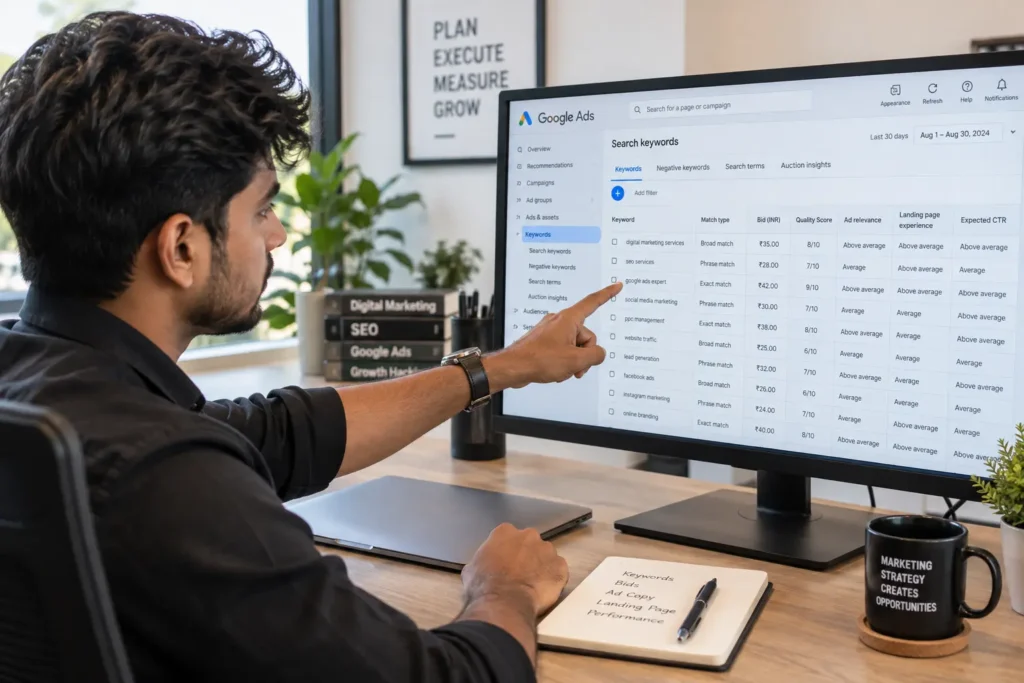
- Check your search terms report on a regular basis in order to detect irrelevant traffic.
- Experiment with various headings and descriptions of ads.
- Ensure that the landing page corresponds to the message from your ad.
If it is difficult to deal with all those factors, it is better to turn to a Google Ads expert and save yourself lots of time spent on trial-and-error.
Final Thoughts
Google’s pay-per-click search ads are possibly the most direct means of reaching an audience that is currently searching for whatever it is that you have to offer. This kind of advertising allows you to achieve speed, pinpoint targeting, and measurability in ways that few other media can.
From a small business owner’s first experience to a seasoned marketing professional trying to refine their approach, the fundamentals discussed above — including keyword research, bidding, Quality Score, and ad types — will give you a good place to start.